

[Jul 19, 2025] Latest PSE-Software Firewall Professional PSE-SWFW-Pro-24 Actual Free Exam Questions
PSE-Software Firewall Professional PSE-SWFW-Pro-24 Dumps Updated Practice Test and 88 unique questions
NEW QUESTION # 36
CN-Series firewalls offer threat protection for which three use cases? (Choose three.)
- A. All Kubernetes workloads in the public and private cloud
- B. Inbound, outbound, and east-west traffic between containers
- C. Prevention of sensitive data exfiltration from Kubernetes environments
- D. All workloads deployed on-premises or in the public cloud
- E. Enforcement of segmentation policies that prevent lateral movement of threats
Answer: B,C,E
Explanation:
CN-Series firewalls are specifically designed for containerized environments.
* Why A, C, and E are correct:
* A. Prevention of sensitive data exfiltration from Kubernetes environments: CN-Series provides visibility and control over container traffic, enabling the prevention of data leaving the Kubernetes cluster without authorization.
* C. Inbound, outbound, and east-west traffic between containers: CN-Series secures all types of container traffic: ingress (inbound), egress (outbound), and traffic between containers within the cluster (east-west).
* E. Enforcement of segmentation policies that prevent lateral movement of threats: CN- Series allows for granular segmentation of containerized applications, limiting the impact of breaches by preventing threats from spreading laterally within the cluster.
* Why B and D are incorrect:
* B. All Kubernetes workloads in the public and private cloud: While CN-Series can protect Kubernetes workloads in both public and private clouds, the statement "all Kubernetes workloads" is too broad. Its focus is on securing the network traffic around those workloads, not managing the Kubernetes infrastructure itself.
* D. All workloads deployed on-premises or in the public cloud: CN-Series is specifically designed for containerized environments (primarily Kubernetes). It's not intended to protect all workloads deployed in any environment. That's the role of other Palo Alto Networks products like VM-Series, PA-Series, and Prisma Access.
Palo Alto Networks References: The Palo Alto Networks documentation on CN-Series firewalls clearly outlines these use cases. Look for information on:
* CN-Series Datasheets and Product Pages: These resources describe the key features and benefits of CN-Series, including its focus on container security.
* CN-Series Deployment Guides: These guides provide detailed information on deploying and configuring CN-Series in Kubernetes environments.
These resources confirm that CN-Series is focused on securing container traffic within Kubernetes environments, including data exfiltration prevention, securing all traffic directions (inbound, outbound, east- west), and enforcing segmentation
NEW QUESTION # 37
Which three statements describe common characteristics of Cloud NGFW and VM-Series offerings? (Choose three.)
- A. In AWS, both offerings can be managed by AWS Firewall Manager.
- B. In Azure and AWS, internal (east-west) flows can be inspected without any NAT.
- C. In Azure, inbound destination NAT configuration also requires source NAT to maintain flow symmetry.
- D. In Azure and AWS, both offerings can be managed by Panorama.
- E. In Azure, both offerings can be integrated directly into Virtual WAN hubs.
Answer: B,C,D
Explanation:
This question asks about common characteristics of Cloud NGFW (specifically referring to Cloud NGFW for AWS and Azure) and VM-Series firewalls.
B . In Azure and AWS, both offerings can be managed by Panorama. This is correct. Panorama is the centralized management platform for Palo Alto Networks firewalls, including both VM-Series and Cloud NGFW deployments in AWS and Azure. Panorama allows for consistent policy management, logging, and reporting across these different deployment models.
D . In Azure, inbound destination NAT configuration also requires source NAT to maintain flow symmetry. This is accurate specifically within the Azure environment. Due to how Azure networking functions, when performing destination NAT (DNAT) for inbound traffic to resources behind a firewall (whether VM-Series or Cloud NGFW), it's typically necessary to also implement source NAT (SNAT) to ensure return traffic follows the same path. This maintains flow symmetry and prevents routing issues. This is an Azure networking characteristic, not specific to the Palo Alto offerings themselves, but it applies to both in Azure.
E . In Azure and AWS, internal (east-west) flows can be inspected without any NAT. This is generally true. For traffic within the same Virtual Network (Azure) or VPC (AWS), both VM-Series and Cloud NGFW can inspect traffic without requiring NAT. This is a key advantage for microsegmentation and internal security. The firewalls can act as transparent security gateways for internal traffic.
Why other options are incorrect:
A . In Azure, both offerings can be integrated directly into Virtual WAN hubs. While VM-Series firewalls can be integrated into Azure Virtual WAN hubs as secured virtual hubs, Cloud NGFW for Azure is not directly integrated into Virtual WAN hubs in the same way. Cloud NGFW for Azure uses a different architecture, deploying as a service within a virtual network.
C . In AWS, both offerings can be managed by AWS Firewall Manager. AWS Firewall Manager is a service for managing AWS WAF, AWS Shield, and network firewalls (AWS Network Firewall). While AWS Firewall Manager can be used to manage AWS Network Firewall, it is not the management plane for Palo Alto Networks VM-Series or Cloud NGFW for AWS. These are managed by Panorama.
Palo Alto Networks Reference:
To validate these points, refer to the following documentation areas on the Palo Alto Networks support site (live.paloaltonetworks.com):
Panorama Administrator's Guide: This guide details the management capabilities of Panorama, including managing VM-Series and Cloud NGFW deployments in AWS and Azure.
Cloud NGFW for AWS/Azure Documentation: This documentation outlines the architecture and deployment models of Cloud NGFW, including its management and integration with cloud platforms.
VM-Series Deployment Guides for AWS/Azure: These guides describe the deployment and configuration of VM-Series firewalls in AWS and Azure, including networking considerations and integration with cloud services.
NEW QUESTION # 38
Which three statements describe benefits of Palo Alto Networks Cloud-Delivered Security Services (CDSS) over other vendor solutions? (Choose three.)
- A. Multi-vendor best-of-breed products provide security coverage on a per-use-case basis.
- B. It provides simplified management through fewer consoles for more effective security coverage.
- C. It requires no additional performance overhead when enabling additional features.
- D. It significantly reduces the total cost of ownership for the customer.
- E. Individually targeted products provide better security than platform solutions.
Answer: B,C,D
Explanation:
Palo Alto Networks Cloud-Delivered Security Services (CDSS) offer several advantages over other security solutions:
* A. Individually targeted products provide better security than platform solutions: This is generally the opposite of Palo Alto Networks' philosophy. CDSS is a platform approach, integrating multiple security functions into a unified service. This integrated approach is often more effective than managing disparate point solutions.
* B. Multi-vendor best-of-breed products provide security coverage on a per-use-case basis: While
"best-of-breed" has its merits, managing multiple vendors increases complexity and can lead to integration challenges. CDSS provides a comprehensive set of security services from a single vendor, simplifying management and integration.
* C. It requires no additional performance overhead when enabling additional features: This is a key advantage of CDSS. Because the services are cloud-delivered and integrated into the platform, enabling additional security functions typically does not introduce significant performance overhead on the firewall itself.
* D. It provides simplified management through fewer consoles for more effective security coverage:
CDSS is managed through Panorama or Strata Cloud Manager, providing a single pane of glass for managing multiple security functions. This simplifies management compared to managing separate consoles for different security products.
* E. It significantly reduces the total cost of ownership for the customer: By consolidating security functions into a single platform and reducing management overhead, CDSS can help reduce the total cost of ownership compared to deploying and managing separate point solutions.
References:
Information about CDSS and its benefits can be found on the Palo Alto Networks website and in their marketing materials:
* CDSS overview: Search for "Cloud-Delivered Security Services" on the Palo Alto Networks website.
This will provide information on the benefits and features of CDSS.
These resources highlight the advantages of CDSS in terms of performance, simplified management, and reduced TCO.
NEW QUESTION # 39
Which three resources can help conduct planning and implementation of Palo Alto Networks NGFW solutions? (Choose three.)
- A. Proof of Concept Labs
- B. Professional services
- C. QuickStart services
- D. Technical assistance center (TAC)
- E. Partners / systems Integrators
Answer: B,C,E
Explanation:
Several resources are available to assist with planning and implementing Palo Alto Networks NGFW solutions:
A . Technical assistance center (TAC): While TAC provides support for existing deployments, they are generally not directly involved in the initial planning and implementation phases. TAC helps with troubleshooting and resolving issues after the firewall is deployed.
B . Partners / systems Integrators: Partners and system integrators play a crucial role in planning and implementation. They possess expertise in network design, security best practices, and Palo Alto Networks products, enabling them to design and deploy solutions tailored to customer needs.
C . Professional services: Palo Alto Networks professional services offer expert assistance with all phases of the project, from planning and design to implementation and knowledge transfer. They can provide specialized skills and best-practice guidance.
D . Proof of Concept Labs: While valuable for testing and validating solutions, Proof of Concept (POC) labs are more focused on evaluating the technology before a full-scale implementation. They are not the primary resources for the actual planning and implementation process itself, though they can inform it.
E . QuickStart services: QuickStart packages are a type of professional service specifically designed for rapid deployment. They provide a structured approach to implementation, accelerating the time to value.
Reference:
Information about these resources can be found on the Palo Alto Networks website and partner portal:
Partner locator: The Palo Alto Networks website has a partner locator tool to find certified partners and system integrators.
Professional services: Details about Palo Alto Networks professional services offerings, including QuickStart packages, are available on their website.
These resources confirm that partners/system integrators, professional services (including QuickStart), are key resources for planning and implementation. While TAC and POCs have roles, they are not the primary resources for this phase.
NEW QUESTION # 40
A prospective customer plans to migrate multiple applications to Amazon Web Services (AWS) and is considering deploying Palo Alto Networks NGFWs to protect these workloads from threats. The customer currently uses Panorama to manage on-premises firewalls and wants to avoid additional management complexity.
Which AWS deployment option meets the customer's technical and business value requirements while minimizing risk exposure?
- A. Cloud NGFWs and Panorama
- B. Cloud NGFWs and Strata Cloud Manager (SCM)
- C. Software NGFW credits and Panorama
- D. Software NGFW credits and Strata Cloud Manager (SCM)
Answer: A
Explanation:
Comprehensive and Detailed In-Depth Step-by-Step Explanation:The customer's requirements involve securing AWS workloads with Palo Alto Networks NGFWs, maintaining consistency with their existing Panorama management for on-premises firewalls, and minimizing management complexity and risk exposure.
The Palo Alto Networks Systems Engineer Professional - Software Firewall documentation provides guidance on deploying NGFWs in AWS, focusing on compatibility with existing management tools.
* Cloud NGFWs and Panorama (Option B): Cloud NGFW for AWS is a cloud-native firewall service that integrates with Panorama for centralized management, ensuring consistency with the customer's existing on-premises firewall management. Panorama provides unified policy enforcement, logging, and monitoring for both on-premises firewalls and Cloud NGFW instances in AWS, avoiding additional management complexity. The documentation highlights this as the ideal solution for customers leveraging Panorama, minimizing risk by maintaining a single management platform while providing advanced threat prevention and application visibility for AWS workloads.
Options A (Software NGFW credits and Strata Cloud Manager [SCM]), C (Cloud NGFWs and Strata Cloud Manager [SCM]), and D (Software NGFW credits and Panorama) are incorrect. SCM (Options A, C) is a cloud-delivered management solution but does not integrate as seamlessly with on-premises firewalls managed by Panorama, introducing complexity for the customer. Software NGFW credits (Options A, D) alone do not specify a deployment option; they are a licensing model, not a firewall type, and do not address management needs directly. Option D omits the specific firewall type (Cloud NGFW) needed for AWS, making it incomplete for meeting the customer's requirements.
References: Palo Alto Networks Systems Engineer Professional - Software Firewall, Section: Multi-Cloud Deployment, Panorama Management Documentation, Cloud NGFW for AWS Deployment Guide.
NEW QUESTION # 41
Which statement applies when identifying the appropriate Palo Alto Networks firewall platform for virtualized as well as cloud environments?
- A. VM-Series firewalls cannot be used to protect container environments.
- B. CN-Series firewalls are used to protect virtualized environments.
- C. All NGFW platforms support API integration.
- D. Panorama is the only unified management console for all NGFWs.
Answer: C
Explanation:
* A . VM-Series firewalls cannot be used to protect container environments: This is incorrect. While CN-Series is specifically designed for container environments, VM-Series can also be used in certain container deployments, often in conjunction with other container networking solutions. For example, VM-Series can be deployed as a gateway for a Kubernetes cluster.
* B . All NGFW platforms support API integration: This is correct. Palo Alto Networks firewalls, including PA-Series (hardware), VM-Series (virtualized), CN-Series (containerized), and Cloud NGFW, offer robust API support for automation, integration with other systems, and programmatic management. This is a core feature of their platform approach.
* C . Panorama is the only unified management console for all NGFWs: This is incorrect. While Panorama is a powerful centralized management platform, it's not the only option. Individual firewalls can be managed locally via their web interface or CLI. Additionally, Cloud NGFW has its own management interface within the cloud provider's console.
* D. CN-Series firewalls are used to protect virtualized environments: This is incorrect. CN-Series is specifically designed for containerized environments (e.g., Kubernetes, OpenShift), not general virtualized environments. VM-Series is the appropriate choice for virtualized environments (e.g., VMware vSphere, AWS EC2).
NEW QUESTION # 42
What are two benefits of using Palo Alto Networks NGFWs in a public cloud service provider (CSP) environment? (Choose two.)
- A. Consistent Security policies throughout the multi-cloud environment
- B. Management of all network traffic in every CSP environment
- C. Deployable in any CSP environment
- D. Automated scaling
Answer: A,D
Explanation:
Comprehensive and Detailed In-Depth Step-by-Step Explanation:Palo Alto Networks Next-Generation Firewalls (NGFWs), such as VM-Series, CN-Series, and Cloud NGFW, are designed to secure public cloud environments like AWS, Azure, and GCP. The Palo Alto Networks Systems Engineer Professional - Software Firewall documentation highlights the following benefits for deploying NGFWs in public cloud service provider (CSP) environments:
* Consistent Security policies throughout the multi-cloud environment (Option B): Palo Alto Networks NGFWs, managed through tools like Panorama or Strata Cloud Manager (SCM), enable consistent security policy enforcement across multiple public cloud providers. This ensures uniformity in security posture, reducing complexity and risk in multi-cloud deployments. The documentation emphasizes the importance of centralized policy management for maintaining consistency, whether using VM-Series, CN-Series, or Cloud NGFW.
* Automated scaling (Option D): NGFWs in public clouds leverage the auto-scaling capabilities of the CSP (e.g., AWS Auto Scaling, Azure Scale Sets) to dynamically adjust resources based on traffic demand. This is particularly true for Cloud NGFW and VM-Series, which integrate with cloud-native load balancers and scaling services to ensure performance without manual intervention, enhancing efficiency and cost-effectiveness.
Options A (Management of all network traffic in every CSP environment) and C (Deployable in any CSP environment) are incorrect. Managing all network traffic in every CSP environment is not feasible due to differences in cloud architectures and native services, and it is not a claimed benefit of Palo Alto Networks NGFWs. While NGFWs are deployable in major CSPs (AWS, Azure, GCP), they are not universally deployable in "any" CSP environment, as compatibility depends on specific integrations and support, making Option C overly broad and inaccurate.
References: Palo Alto Networks Systems Engineer Professional - Software Firewall, Section: Public Cloud Security, Multi-Cloud Deployment Guide, Automated Scaling Documentation for VM-Series and Cloud NGFW.
NEW QUESTION # 43
What is required to manage a VM-Series firewall with Panorama?
- A. VM-Series REST API script
- B. VM-Series firewall plugin
- C. VPN connection from the firewall to Panorama
- D. Panorama template
Answer: B
Explanation:
Comprehensive and Detailed In-Depth Step-by-Step Explanation:Panorama is Palo Alto Networks' centralized management platform for managing firewalls, including VM-Series, across various environments.
The Palo Alto Networks Systems Engineer Professional - Software Firewall documentation outlines the requirements for integrating and managing VM-Series firewalls with Panorama.
* VM-Series firewall plugin (Option C): To manage VM-Series firewalls with Panorama, the VM-Series firewall plugin must be installed and enabled in Panorama. This plugin allows Panorama to recognize and manage VM-Series instances, enabling centralized policy enforcement, configuration management, logging, and monitoring. The documentation specifies that the plugin is essential for integrating virtual firewalls into Panorama, ensuring compatibility and functionality for both public cloud and on-premises deployments.
Options A (VPN connection from the firewall to Panorama), B (VM-Series REST API script), and D (Panorama template) are incorrect. A VPN connection (Option A) is not required for management; Panorama communicates with VM-Series via secure channels (e.g., HTTPS) over the network, not necessarily a VPN. A VM-Series REST API script (Option B) is used for automation, not for general management integration with Panorama, which relies on the plugin. Panorama templates (Option D) are used for configuration management but are not a requirement for managing VM-Series; the plugin is the critical component for integration.
References: Palo Alto Networks Systems Engineer Professional - Software Firewall, Section: Panorama Management, VM-Series Integration Guide, Panorama Plugins Documentation.
NEW QUESTION # 44
A company has purchased Palo Alto Networks Software NGFW credits and wants to run PAN-OS 11.x virtual machines (VMs).
Which two types of VMs can be selected when creating the deployment profile? (Choose two.)
- A. Flexible model of working memory
- B. Flexible vCPUs
- C. Fixed vCPU models
- D. VM-100
Answer: B,C
Explanation:
When using Software NGFW credits and deploying PAN-OS VMs, specific deployment models apply.
* Why B and D are correct:
* B. Fixed vCPU models: These are pre-defined VM sizes with a fixed number of vCPUs and memory. Examples include VM-50, VM-100, VM-200, etc. When using fixed vCPU models, you consume a fixed number of credits per hour based on the chosen model.
* D. Flexible vCPUs: This option allows you to dynamically allocate vCPUs and memory within a defined range. Credit consumption is calculated based on the actual resources used. This provides more granular control over resource allocation and cost.
* Why A and C are incorrect:
* A. VM-100: While VM-100 is a valid fixed vCPU model, it's not a type of VM selection. It's a specific instance within the "Fixed vCPU models" type. Choosing "VM-100" is choosing a specific fixed vCPU model.
* C. Flexible model of working memory: While you do configure the memory alongside vCPUs in the flexible model, the type of selection is "Flexible vCPUs." The flexible model encompasses both vCPU and memory flexibility.
Palo Alto Networks References:
The Palo Alto Networks documentation on VM-Series firewalls in public clouds and the associated licensing models (including the use of credits) explicitly describe the "Fixed vCPU models" and "Flexible vCPUs" as the two primary deployment options when using credits. The documentation details how credit consumption is calculated for each model.
Specifically, look for information on:
* VM-Series Deployment Guide for your cloud provider (AWS, Azure, GCP): These guides detail the different deployment options and how to use credits.
* VM-Series Licensing and Credits Documentation: This documentation provides details on how credits are consumed with fixed and flexible models.
For example, the VM-Series Deployment Guide for AWS states:
* Fixed vCPU models: These are pre-defined VM sizes... You select a specific VM model (e.g., VM-50, VM-100, VM-300), and you are billed a fixed number of credits per hour.
* Flexible vCPUs: This option allows you to specify the number of vCPUs and amount of memory...
You are billed based on the actual resources you use.
NEW QUESTION # 45
Why should a customer use advanced versions of Cloud-Delivered Security Services (CDSS) subscriptions compared to legacy versions when creating or editing a deployment profile?
(e.g., using Advanced Threat Prevention instead of Threat Prevention.)
- A. To download and install new threat-related signature databases in real-time
- B. To use external dynamic lists for blocking known malicious threat sources and destinations
- C. To improve firewall throughput by inspecting hashes of advanced packet headers
- D. To use cloud-scale machine learning inline for detection of highly evasive and zero-day threats
Answer: D
Explanation:
Advanced CDSS subscriptions offer enhanced threat prevention capabilities:
A . To improve firewall throughput by inspecting hashes of advanced packet headers: While some security features use hashing, this is not the primary advantage of advanced CDSS.
B . To download and install new threat-related signature databases in real-time: Both standard and advanced CDSS subscriptions receive regular threat updates.
C . To use cloud-scale machine learning inline for detection of highly evasive and zero-day threats: This is a key differentiator of advanced CDSS. It leverages cloud-based machine learning to detect sophisticated threats that traditional signature-based methods might miss.
D . To use external dynamic lists for blocking known malicious threat sources and destinations: Both standard and advanced CDSS can use external dynamic lists.
Reference:
Information about the specific features of advanced CDSS, such as inline machine learning, can be found on the Palo Alto Networks website and in datasheets comparing different CDSS subscription levels.
NEW QUESTION # 46
Which feature allows customers to dynamically increase the capability of their VM-Series firewalls without needing to increase performance they do not need?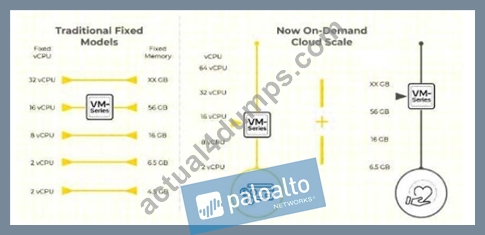
- A. Increased fixed vCPUs and memory
- B. Elastic Memory Profiles
- C. Increased RAM cache
- D. Elastic vCPU profiles
Answer: D
Explanation:
Comprehensive and Detailed In-Depth Step-by-Step Explanation:The Palo Alto Networks Systems Engineer Professional - Software Firewall documentation describes the flexible licensing and resource management options for VM-Series firewalls, particularly under PAN-OS 11.x and later versions. The question focuses on dynamically adjusting VM-Series firewall capabilities (e.g., performance and throughput) without over- provisioning unnecessary resources, a key feature of Palo Alto Networks' credit-based flexible licensing model.
* Elastic vCPU profiles (Option A): Elastic vCPU profiles, part of the flexible licensing model for VM- Series firewalls, allow customers to dynamically adjust the number of virtual CPUs (vCPUs) allocated to their firewalls based on current performance needs. This is enabled through NGFW credits managed in the Palo Alto Networks Customer Support Portal or Strata Cloud Manager, where deployment profiles can be configured with flexible vCPU counts (e.g., 2, 4, 8, 16, 32, or 64 vCPUs, corresponding to Tiers 1-4). The documentation highlights that this feature enables customers to scale up or down vCPU resources without over-provisioning fixed performance (e.g., memory or throughput) they do not need, ensuring cost efficiency and scalability in public clouds (e.g., AWS, Azure, GCP) and private clouds. The diagram in the question contrasts traditional fixed models (e.g., VM-100 with fixed vCPUs and memory) with the "On-Demand Cloud Scale" approach, where elastic vCPU profiles allow dynamic adjustment (e.g., adding vCPUs as shown by the upward arrow) without increasing unnecessary performance, aligning with the question's intent.
Options B (Increased RAM cache), C (Increased fixed vCPUs and memory), and D (Elastic Memory Profiles) are incorrect. Increased RAM cache (Option B) is not a configurable feature for VM-Series firewalls and does not address dynamic capability adjustment; RAM is tied to vCPU tiers but not independently scalable in this context. Increased fixed vCPUs and memory (Option C) refers to traditional fixed models (e.g., VM-100, VM-
300), which do not allow dynamic scaling and would over-provision performance the customer does not need, contradicting the question's focus on avoiding unnecessary increases. Elastic Memory Profiles (Option D) is not a recognized feature in the documentation for VM-Series; memory allocation is linked to vCPU tiers, but there is no standalone "elastic memory" option, making this inaccurate. The documentation emphasizes elastic vCPU profiles as the solution for dynamic, on-demand scaling without over-provisioning, as shown in the diagram's "On-Demand Cloud Scale" visualization.
References: Palo Alto Networks Systems Engineer Professional - Software Firewall, Section: VM-Series Flexible Licensing, Elastic vCPU Profiles Documentation, NGFW Credits and Deployment Profiles Guide, PAN-OS 11.x Deployment and Scaling Documentation.
NEW QUESTION # 47
Which tool facilitates a customer's migration from existing legacy firewalls to Palo Alto Networks Next-Generation Firewalls (NGFWs)?
- A. Expedition
- B. IronSkillet
- C. Policy Optimizer
- D. AutoFocus
Answer: A
Explanation:
Why A is correct: Expedition is a tool specifically designed to automate the migration of configurations from various legacy firewalls to Palo Alto Networks NGFWs. It helps parse existing configurations and translate them into PAN-OS policies.
Why B, C, and D are incorrect:
B: Policy Optimizer helps refine existing PAN-OS policies but doesn't handle migration from other vendors.
C: AutoFocus is a threat intelligence service, not a migration tool.
D: IronSkillet is a collection of security best-practice configurations for PAN-OS, not a migration tool.
Palo Alto Networks Reference: The Expedition documentation and datasheets explicitly describe its role in firewall migrations.
NEW QUESTION # 48
Which three statements describe restrictions or characteristics of Firewall flex credit profiles of a credit pool in the Palo Alto Networks customer support portal? (Choose three.)
- A. All firewalls activated to a deployment profile will have the same Cloud-Delivered Security Services (CDSS).
- B. Allocate credits for use with Cloud NGFW for AWS and Azure.
- C. Each deployment profile is either CN-Series firewall or VM-Series firewall.
- D. The number of licensed cores must match the number of provisioned CPU cores per instance.
- E. Each VM-Series firewall deployment profile is either fixed or flexible.
Answer: A,D,E
Explanation:
Firewall flex credits have specific characteristics.
* Why A, C, and D are correct:
* A: For flex credits, the number of licensed cores must match the number of provisioned CPU cores. This is a key requirement for accurate credit consumption.
* C: Deployment profiles are either fixed (predefined resources) or flexible (using credits).
* D: All firewalls within a deployment profile share the same Cloud-Delivered Security Services (CDSS) subscriptions.
* Why B and E are incorrect:
* B: Flex credits are the mechanism used to deploy Cloud NGFW instances in AWS and Azure, not a separate allocation.
* E: Deployment profiles are for VM-Series firewalls. CN-Series firewalls have their own licensing and deployment models.
Palo Alto Networks References: The official Palo Alto Networks documentation on VM-Series licensing, flex credits, and deployment profiles contains this information.
NEW QUESTION # 49
What are three benefits of using Palo Alto Networks software firewalls in public cloud, private cloud, and hybrid cloud environments? (Choose three.)
- A. They allow for centralized management of all firewalls, regardless of where or how they are deployed.
- B. They provide consistent policy enforcement across all architectures, whether on-premises or in the cloud.
- C. They allow management of underlying public cloud architecture without needing to leave the firewall itself.
- D. They allow for complex management of per-use case security needs through multiple point products.
- E. They create a simplified consumption and deployment model throughout the production environment.
Answer: A,B,E
Explanation:
Palo Alto Networks software firewalls offer key advantages in various cloud environments.
Why A, C, and E are correct:
A: Centralized management through Panorama allows for consistent policy enforcement and simplified operations across all deployments, regardless of location (public, private, or hybrid cloud).
C: Consistent policy enforcement is a core benefit, ensuring that security policies are applied uniformly across all environments, reducing complexity and improving security posture.
E: A simplified consumption and deployment model streamlines operations and reduces the overhead associated with managing multiple security solutions. This is achieved through consistent interfaces and automation capabilities.
Why B and D are incorrect:
B: Palo Alto Networks advocates for a consolidated security platform approach, not managing multiple point products. The goal is to simplify, not complicate, security management.
D: While Palo Alto Networks firewalls integrate with cloud platforms, they don't manage the underlying cloud infrastructure itself. That's the responsibility of the cloud provider.
Palo Alto Networks Reference: The Palo Alto Networks Next-Generation Security Platform documentation, as well as materials on Panorama and cloud security, highlight these benefits of centralized management, consistent policy, and simplified operations. For example, the Panorama admin guide details how it can manage firewalls across different deployment models.
NEW QUESTION # 50
Which three statements describe functionality of NGFW inline placement for Layer 2/3 implementation? (Choose three.)
- A. VM-Series next-generation firewalls cannot be positioned between the physical datacenter network and guest VM workloads.
- B. VM-Series next-generation firewalls do not support VMware vMotion or guest VM workloads.
- C. VMs on VMware ESXi hypervisors can be segregated from each other by the VM-Series NGFW using VLAN tags while preserving existing Layer 3 gateways.
- D. A next-generation firewall VLAN interface can function as a Layer 3 interface.
- E. VMs on VMware ESXi hypervisors can be segregated from one another on the network by the VM-Series NGFW by IP addressing and Layer 3 gateways.
Answer: C,D,E
Explanation:
Let's analyze each option based on Palo Alto Networks documentation and best practices:
A . VMs on VMware ESXi hypervisors can be segregated from one another on the network by the VM-Series NGFW by IP addressing and Layer 3 gateways. This is TRUE. The VM-Series firewall can act as a Layer 3 gateway, enabling inter-VLAN routing and enforcing security policies between different VM networks based on IP addresses and subnets. This allows for granular control over traffic flow between VMs.
Reference:
B . VMs on VMware ESXi hypervisors can be segregated from each other by the VM-Series NGFW using VLAN tags while preserving existing Layer 3 gateways. This is also TRUE. The VM-Series supports 802.1Q VLAN tagging. This allows the firewall to inspect traffic between VMs residing on different VLANs without requiring changes to the existing network infrastructure's Layer 3 gateways. The firewall acts as a "bump in the wire" for VLAN traffic, enforcing security policies without disrupting existing routing.
C . VM-Series next-generation firewalls cannot be positioned between the physical datacenter network and guest VM workloads. This is FALSE. This is a primary use case for VM-Series firewalls. They are frequently deployed to protect virtualized workloads by sitting between the physical network and the VMs, inspecting and controlling all traffic entering and leaving the virtual environment.
D . VM-Series next-generation firewalls do not support VMware vMotion or guest VM workloads. This is FALSE. The VM-Series fully supports vMotion. When a VM migrates from one ESXi host to another, the VM-Series firewall policies seamlessly follow the VM, ensuring consistent security enforcement.
E . A next-generation firewall VLAN interface can function as a Layer 3 interface. This is TRUE. A VLAN interface on a Palo Alto Networks firewall (physical or virtual) can be configured with an IP address and act as a Layer 3 interface, participating in routing and providing connectivity to different networks. This is a fundamental aspect of firewall functionality.
Therefore, the correct answers are A, B, and E. They accurately describe the functionality of NGFW inline placement in Layer 2/3 implementations with VM-Series firewalls.
NEW QUESTION # 51
Which three resources are deployment options for Cloud NGFW for Azure or AWS? (Choose three.)
- A. Palo Alto Networks Ansible playbooks
- B. Azure Portal
- C. AWS Firewall Manager
- D. Azure CLI or Azure Terraform Provider
- E. Panorama AWS and Azure plugins
Answer: A,B,D
Explanation:
Cloud NGFW for Azure and AWS can be deployed using various methods.
Why A, B, and E are correct:
A . Azure CLI or Azure Terraform Provider: Cloud NGFW for Azure can be deployed and managed using Azure's command-line interface (CLI) or through Infrastructure-as-Code tools like Terraform. Cloud NGFW for AWS can be deployed and managed using AWS CloudFormation or Terraform.
B . Azure Portal: Cloud NGFW for Azure can be deployed directly through the Azure portal's graphical interface.
E . Palo Alto Networks Ansible playbooks: Palo Alto Networks provides Ansible playbooks for automating the deployment and configuration of Cloud NGFW in both Azure and AWS.
Why C and D are incorrect:
C . AWS Firewall Manager: AWS Firewall Manager is an AWS service for managing AWS WAF, AWS Shield, and VPC security groups. It is not used to deploy Cloud NGFW.
D . Panorama AWS and Azure plugins: While Panorama is used to manage Cloud NGFW, the deployment itself is handled through native cloud tools (Azure portal, CLI, Terraform) or Ansible.
Palo Alto Networks Reference:
Cloud NGFW for Azure and AWS Documentation: This documentation provides deployment instructions using various methods, including the Azure portal, Azure CLI, Terraform, and Ansible.
Palo Alto Networks GitHub Repositories: Palo Alto Networks provides Ansible playbooks and Terraform modules for Cloud NGFW deployments.
NEW QUESTION # 52
......
Verified PSE-SWFW-Pro-24 dumps Q&As - 100% Pass from Actual4Dumps: https://freetorrent.actual4dumps.com/PSE-SWFW-Pro-24-study-material.html